Psychological Stoicism Part 8: A Stoic Approach to Ageing
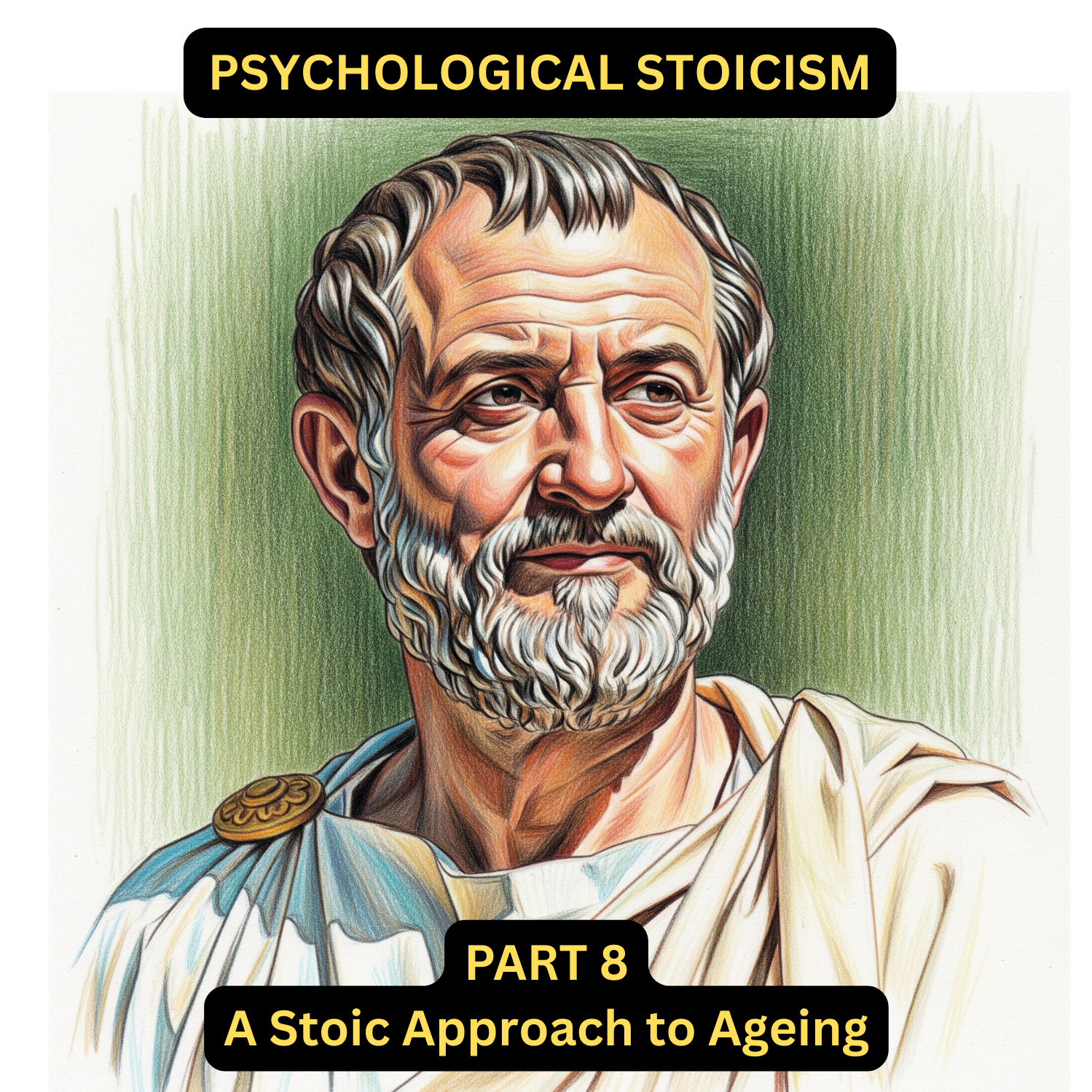
As I write this, I find myself at the age of 57. A few years ago, I started to notice that I was often the oldest person in the room, which led to a curious practice. Whether at a work meeting, in a café, or on a train, I would scan my surroundings to see if I was indeed the oldest person around. If I spotted someone obviously older, I’d feel a sense of relief, sometimes even offering a kindly half-smiling nod, while they stared back nervously.
We’re all getting older, yet as our 40s tick over into our 50s and 60s, there is an almost imperceptible shift in outlook toward the final period of our lives. This is often quite hazy because we prefer not to focus on it, keeping it at arm’s length. It can be scary to think about how many years we have left. Most people dislike the idea of ageing so much that they avoid thinking about it altogether. Rather than processing these uncomfortable feelings or planning for the future, we distract ourselves or talk in jokey cliches about reading glasses, bus passes, and ‘senior moments' to hide our discomfort. The Stoics suggested a different path. They argued that facing our ageing head-on is key to living well.
I had quite a difficult start to life, or so I’m told. I was born six weeks premature and spent my first few weeks in an incubator being fed and monitored until I was considered strong enough to face the real world. Following this shaky start, I’ve enjoyed more than half a century of good health. Sport always came naturally to me and I have exercised my whole life, without any real injuries or physical setbacks. Until recently, I couldn’t imagine life being any different.
Then, in my mid-fifties, the Stoic gods handed me a challenge. I developed plantar fasciitis, a painful condition that made running impossible and walking painful. I'd had foot injuries in my youth, mainly from playing football, and would bounce back quickly. This time, my physio told me my foot would take about three to four months to heal. I thought that she was being overly pessimistic, but it turned out that she was being optimistic; my foot took more than nine months to properly heal. Ouch.
During this time I had to drastically reduce my walking. When I did venture out, I had to carefully tape my foot up. The running joke in my house was, “Have you taped your foot yet? We need to leave in an hour!” Very funny. I had to replace all the soles in my footwear with specially made inserts and stretch my foot for ten minutes after each walk.
I lost some fitness and muscle strength during this period. When I finally recovered and started exercising again, I tore the meniscus in my knee. To take pressure off the knee, I changed my gait, which led to a strained muscle at the top of my leg. This, in turn, caused nerve damage and intense lower back pain, leaving me taking painkillers for the first time in my life. It was a further three months until I fully recovered. In total, I was unable to do any meaningful exercise for about two years. Thankfully, with some good advice from the physio and a very slow, careful reintroduction to movement, I am now back to regular running.
This succession of injuries gave me a taste of what the Stoic William Irvine calls the “domino effect” of ageing. When we’re young, we bounce back, but as we get older, even small injuries can be the first of many dominoes to fall. Each becomes more significant than the last. I had watched this exact process happen to my dad. He developed arthritis in his hip in his 70s, which led to him using a walking stick. One day, his stick caught in the carpet, causing him to fall and break his hip. This led to a long hospital stay and a loss of mobility. As he sat more, he developed oedema (excess fluid in the legs), making it even harder to walk. Due to this lack of movement, his cardiovascular system deteriorated, resulting in congestive heart failure. And so it went on, until he was unable to leave the house.
Applying the Stoic Test Strategy
Although I had difficult days during those two years, after a short while, I managed to put my "Stoic big boy pants" on. I began to see my situation as an opportunity to practise my favourite Stoic tool: the Stoic Test Strategy. By framing my physical setbacks as a test of my character, I accepted the situation and sought out workarounds while remaining calm.
I knew running was out of the question for a while, and I came to terms with that quickly. However, I soon realised that walking any real distance was also a struggle. This was a low point. While I rely on my legs for my commute, I walk primarily for the love of it. Losing that daily freedom hit me hard. What to do?
One solution came quickly. I rescued my forgotten bike from the garage and used a simple kit to convert it into an e-bike. I don’t see myself as practical, but I enjoyed the project. Now, if the pedalling became too strenuous, I could let the battery take the strain. I replaced my weekend walks with long rides in the countryside, discovering places that would have been too far to reach on foot. Indeed, it felt liberating to go faster and further than normal.
Whilst I don’t mind being behind the wheel of a car, I’ve never found any great joy in driving. However, I realised I would have to rely on my car more during recovery.. Around this time, I read a study linking certain driving habits to dementia.It suggested that increased rates of dementia were linked to decreased driving time and always taking the same routes. Time for a mindset change. I framed this period as an "anti-dementia" brain-building exercise—using new routes and avoiding the sat-nav whenever possible.
Finding Silver Linings
I also responded to the challenges by searching for silver linings. The first was that these injuries served as a wake-up call; they made me aware of how much I had taken my health for granted. This caused me to reflect on my dad’s situation and how I could avoid a similar outcome. Compared to when my dad’s issues began, I still had age on my side.
I’d always been aware that I was a little inflexible, so I decided to learn Tai Chi. After just a month of practising, I became more agile and sure-footed. I also found that my blood pressure and resting heart rate dropped significantly, and I felt a lot less stressed in general.
Since moving through my fifties, I’ve discovered more upsides to ageing. One of the most significant developments is increased self-confidence. I know who I am and what my values are. I’m not as sensitive to criticism, and my anxiety, both social and general, has faded to almost nothing. The shyness that had felt like an insurmountable obstacle has almost evaporated, and I now find myself chatting with complete strangers.
The ancient Stoics were well aware of these hidden benefits. In the words of Seneca: “Let us cherish and love old age, for it is full of pleasures if one knows how to use it.” He goes even further, claiming the most delightful time of life is “when it is on the downward slope, but has not yet reached the abrupt decline.”
Empathy Over Cynicism
You would think that getting older means you’re less surprised by the world and more cynical of human nature, but I have found the opposite. In Meditations, Marcus Aurelius reminds us to delight ourselves when we think of the virtues of others. This is backed up by research in positive psychology referred to as ‘savouring’; the act of noticing and appreciating the positive aspects of life.
Following the advice of Marcus Aurelius, I now look for small acts of spontaneous kindness. Like the teenager I saw yesterday who noticed an elderly woman couldn’t reach a shelf in a supermarket. He tapped her on the shoulder, reached for the item, and placed it in her basket with a smile. There’s plenty of bad behaviour too, of course, but when you look for virtuous acts, you find them in abundance.
So, getting older has made me more aware of the joys and challenges of others’ lives. I am slower to judge; empathy comes more easily, and I can celebrate others’ successes without envy. People often worry that becoming more empathetic makes them a 'pushover'. However, the self-awareness that comes with experience has also made me wiser to bad actors. I now feel unafraid to cut off manipulation and disrespectful behaviour calmly and politely. I stand my ground when necessary, and it causes far less discomfort than it would have in my younger years.
Finding Peace and Equanimity
Of course, this doesn’t mean life is always perfect. I still have short periods of intense anxiety that appear out of nowhere. There was a time when everything would come to a stop and I would hide away or fight it. However, I now know that it will pass. I just allow the anxiety to be there. I watch it develop, like a wave building in power, and just wait it out. I often find myself engaged in a task and realise that, like a polite guest who didn’t want to disturb me, the anxiety has quietly left without saying a word. This ability to cope with strong emotions is a silver lining that has come with age.
Ageing has taught me three transforming principles: balance, curiosity, and flexibility. While I am not perfect, the majority of the time I am able to quickly find peace and equanimity.
The Upside of Losing Pleasure
Seneca suggested that as we lose the ability to experience certain pleasures, we also lose the compulsion to seek them: “How comforting it is, to have tired out one's appetites and have done with them.” Although he doesn’t mention it specifically, the "passions of youth" are clearly his focus. The playwright Sophocles once likened losing his romantic drives to escaping a "savage and tyrannical master." Hollywood Film Director John Huston echoed this, telling actor George Hamilton that losing his libido was “like getting off a wild horse.” Whilst this might not sound like something to look forward to, it is not the complete abandonment of sexual urges that is the prize, but rather the ability and wisdom to temper them when they don’t serve you or are wildly talking you off course.
A Positive Ageing Mindset
When I was a teenager I remember listening to the Beatles’ song “When I'm Sixty-Four” and just not being able to imagine myself in my sixties, it was too weird a concept, and too terrifying to contemplate. I just couldn’t do it. Well, in around three years time I will enter my sixties and it no longer feels strange to picture myself at that age, as I’ve slowly been preparing myself for it as the years have ticked by. I no longer find it frightening.
I recently read an interview with Irvine Welsh, the writer of Trainspotting. Now in his late 60s, he talked about how he doesn’t think about getting older or his mortality at all. He is just thinking about life. I can understand that philosophy, and if it works for him, fine, but the Stoics considered regularly contemplating old age, and even death, fundamental to ageing well. I have found that rather than ageing you prematurely, contemplating getting older is part of a positive ageing mindset that helps you to make the most of life now, in the present, while also preparing for what is to come with calmness, optimism, and an appetite to squeeze the last drop out of every day. Contemplating the ageing process has motivated me to prioritise my physical and mental health, rather than living as if life was going to go on forever.
Now what I think would be weird is to be a teenager again. All that insecurity about who you are and what you want. Hormones pulling you in one direction and then the other. We have to go through this rollercoaster of uncertainty in order to get the chance to experience the privilege of equanimity half a century later. I loved my teenage years but I prefer my older and wiser mind
So, practise embracing ageing. Accept its unavoidable limitations and changes when they come, but approach it with a positive mindset. A study by Becca Levy, an academic at Yale, found that having a positive mindset about ageing increased the will to live and led to an extra seven years of healthy longevity. Keep moving, keep learning, develop your curiosity, be social, and appreciate the silver linings that ageing brings..